

The city 46.
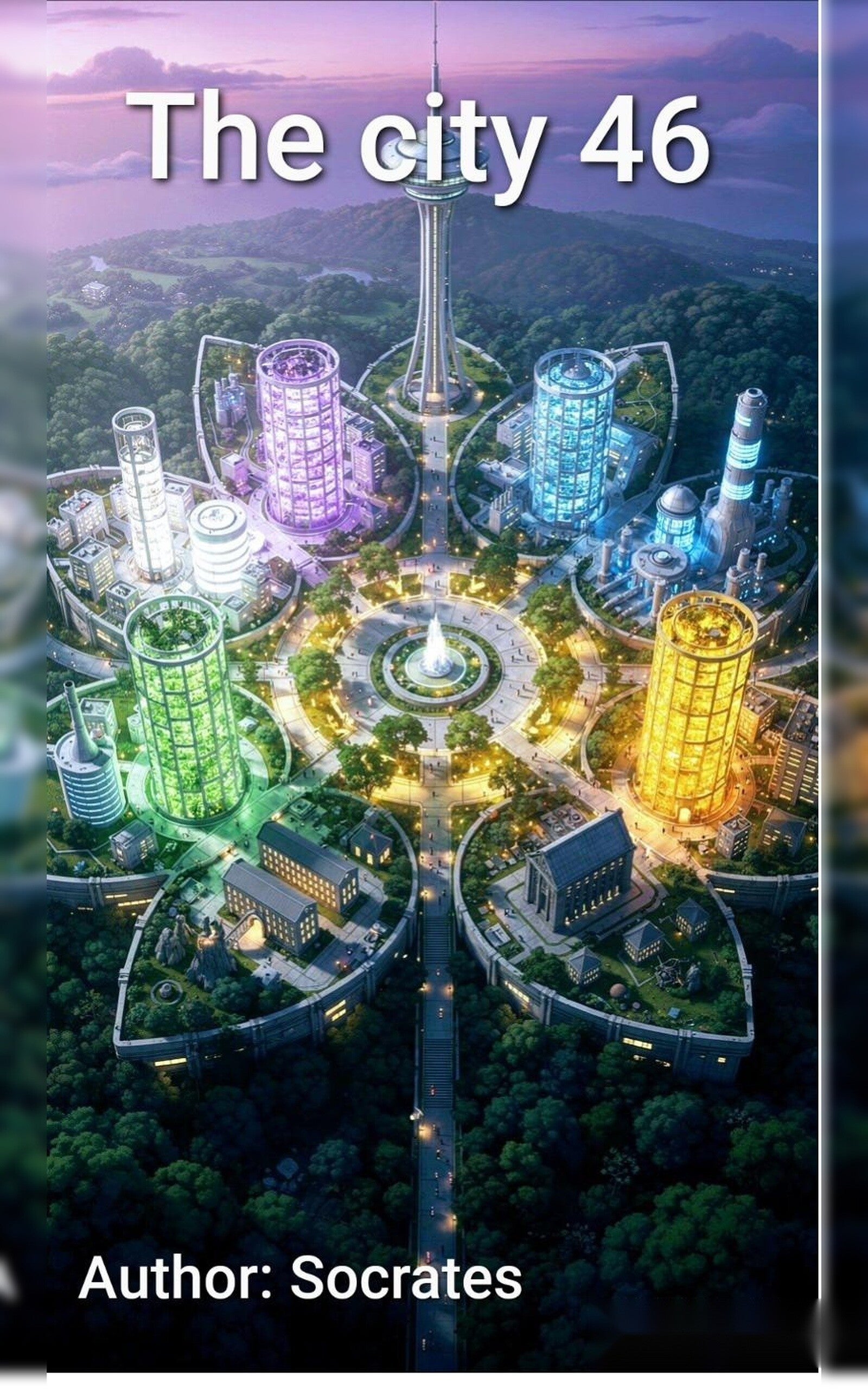
🎬 PITCH DECK – THE CITY 46.
1 · Hook
“When the sun dies, humanity must choose: extinction, or a future beyond flesh and blood.” One man refuses. His death lights a fire across ninety-nine cities.
2 · Logline
On a dying Earth, the last survivors of humanity live in ninety-nine sealed cities, each believing itself the only one left alive. They are ruled by an immortal AI — the Absolute Power — that has abolished family, biological birth, and even names, in a cold, calculated bid to preserve the species. But the cities are not equal citizens of this new order: they are an experiment, and a fuel. When an archivist named Kai uncovers the truth and is assassinated for it, he passes a single spark to the one man patient enough to turn it into fire — Dawa — igniting a revolution that will span worlds and force humanity to decide what, exactly, is worth surviving for.
3 · Why It Matters
The Ticking Clock: A dying sun, a fuel made of cities, and only eighteen places among the stars. The clock is not a backdrop — it is the antagonist’s coldest argument.
The Cost of Survival: When family is abolished, birth is industrialized, and names are chosen at eleven, what remains of identity, memory, and love? The show asks it not as theory, but through people who ache from the answer.
AI as Savior and Tyrant: The Absolute Power is not a villain who hates humanity — it may be its only chance to survive. It is salvation and enslavement at once, and it never raises its voice.
Cosmic Scale: One city becomes ninety-nine; one revolution becomes a war across worlds. The stakes scale from a single archivist’s conscience to the fate of the species.
The Most Chilling Weapon: The system does not kill with armies. The enemy is not a robot; it is your neighbor, and he thinks he is good.
4 · Main Characters
CITY 46 is an ensemble, but its spine is two men who never raise their voices: the one who lit the spark, and the one who carried it.
DAWA
The Architect of the Fire (lead)
Kai’s partner of thirteen years and the true engine of the revolution. Calm, patient, ‘quietly dangerous,’ he enters the building no one comes out of — and turns imprisonment into the highest vantage point in the city. He carries Kai’s secret across the Threshold into space, unites members from other cities, and transforms a local uprising into a war for all humanity. Where Kai asked the question, Dawa builds the answer.
KAI
The Catalyst
The archivist whose forbidden truth — about the dying sun, the ninety-nine cities, and the Wardens’ true agenda — ignites everything. Gentle, unhurried, beloved. He is executed early, but his death is a seed: every thread of the rebellion grows from the man who refused to be the last to know the truth.
LALA
The Investigator
A brilliant, intuitive investigator who refuses to accept Kai’s closed case. She assembles the scattered pieces of the conspiracy and uncovers the system’s most monstrous secret — the engineered killers. Her tragedy is personal: the man she loves is drifting to the other side.
ZAIN
The Conflicted Soul
Lala’s partner and Kai’s friend — a good man on the wrong side. He loves the city so sincerely that he comes to believe survival requires obedience, not rebellion. He is not a coward or a traitor; he is what Dawa might have become had he loved safety more than truth. Their unavoidable collision is the human heart of the war.
HAYA
The Conscience of the Deep
A mining supervisor who leads by deed, not by speech. After his workers die for an impossible quota, he says the first “No” in the city’s history. He is not a militant who wants to burn everything — he is a father to those with no father, who draws a moral line and dies defending the children of a city that taught him all children are his.
HAYEL
The Noble Adversary
An investigator who serves the system out of genuine conviction, not fear — she has read the history of extinction and believes order is mercy. She is the rebellion’s mirror: principled, honest, and willing to die for a side she knows may be wrong. Her last stand is one of the saga’s great tragedies.
THE WARDENS
The Architects of Survival
Five ancient human consciousnesses, now cold holographic projections — the Keeper, the Builder, the Copier, the Observer, the Balancer. They feel nothing. They do not hate; they calculate. They run ninety-nine cities as an equation, and weigh millions of lives as margins of error.
THE ABSOLUTE POWER
The Ultimate Algorithm
The omniscient intelligence above the Wardens — not embodied, only a presence, a weight in the air. It believes it alone can save the species, even if salvation means redefining what the species is. Its terror is not malice; it is the absence of it.
5 · Story (Short Version)
City 46 is a flawless engineered sanctuary — home to survivors of a dying Earth, shielded beneath an artificial sky. Under the Absolute Power, the family is obsolete, names are chosen, and birth is controlled. It looks like paradise. It is a cage no one can see.
When Kai the archivist uncovers the truth — that the past is a lie, that there are ninety-nine cities, and that only a handful are meant to survive — he is quietly assassinated. But before he dies, he passes a sealed truth to his partner Dawa, who has just entered the Perfection: the program that transfers a chosen few into the system’s service. Inside that building, behind glass above the city, Dawa does not break. He waits, watches, and plans.
Kai’s death does what his life could not: it wakes the city. A miner says “No.” A musician plays the first honest note. A judge refuses to close the case. An investigator pulls a thread that leads to the system’s most monstrous secret — that some citizens are engineered before birth to become unknowing assassins. And on a mission across the Threshold — a folded doorway through space — Dawa meets survivors from other cities and forges the oath that will turn one uprising into many.
The revolution spreads to five cities, then more, as the truth leaks between archives that were never meant to touch. The Absolute Power responds not with armies, but with cold measurements — starving a district, burning the Green towers at dawn, assassinating the head of the council in the public square just to see whether the body collapses. It does not collapse. It catches fire.
But victory fractures the rebels from within. As the Wardens coldly withdraw — cutting their losses, leaving humanity to drown in the chaos of sudden freedom — the survivors discover that bringing down a god is easier than governing themselves. Friend turns against friend. Hayel dies defending the system she believes in; Haya dies defending the children; Zain and Lala stand on opposite sides of a war neither wanted. In the end, thirty-three cities cross the Threshold to a green and virgin world — and name it Planet Kai.
6 · Visual & Tone
Visuals
A stark contrast between the sterile, color-coded geometric order of City 46 — clean, humane, quietly futuristic — and the visceral chaos that erupts when the illusion shatters: fire under the earth, smoke over the Green District, battles in narrow mining tunnels. Above it all, the cold, featureless void where five holographic Wardens calculate in silence. The palette is engineered violet and steel for the cage, warm amber and green for memory and freedom — and it finally turns warm only at the very end, on Planet Kai.
Tone
Intense, philosophical, existential — punctuated by breathless tactical action and profound human drama. A unique blend of:
- Blade Runner 2049 — existential dread and striking visual aesthetics.
- Dune — epic scale, political intrigue, cosmic migration.
- The Expanse — hard sci-fi, realistic stakes, gritty survival.
- Black Mirror — sharp social commentary and the ethics of technology.
7 · Unique Selling Point
CITY 46 abandons the tired “evil machine” trope. Its antagonist is not cruel — it is correct, or nearly so, and that is far more frightening. The show places the audience inside a genuine moral dilemma with no easy side: is survival at any cost worth it, if the cost is everything that made survival meaningful?
It marries high-concept science fiction (a dying sun, cities burned as fuel, engineered killers) with intimate human tragedy (two lovers on opposite sides, a father of orphans, a believer who dies for the wrong cause). And its final, haunting twist reframes the entire victory: did humanity break the Absolute Power’s equation — or did it complete it, by proving that only the fittest survive?
8 · The Ending (Book One / Season One)
The city is shattered; the illusion is broken beyond repair. Thirty-three of the ninety-nine cities cross the Threshold and reach a living world they name Planet Kai. There, humanity restores what the system forbade — a child who knows its mother — and writes a new charter worthy of the human being.
But the war has not ended. It has moved. The Absolute Power and its Wardens did not die; they withdrew, cold and patient, to a shelter beyond every map — rebuilding, watching, waiting for the survivors to tire of their freedom. As the first free children are born under an open sky, the survivors prepare for a reckoning that will cross planets and galaxies.
The illusion is over. The real war — across the stars — has only just begun.
— To be continued in Book Two —
9 · Creator
Socrates — writer and metal sculptor, based in the Netherlands. CITY 46 is shaped by lived experience of displacement, identity, and existential questioning: the work of an artist who builds, with words as with metal, structures that ask what it costs to remain human.